General
Minnesota MPCA PFAS Reporting Update – October 27, 2026
By GS Comply Solutions · · 11 min read
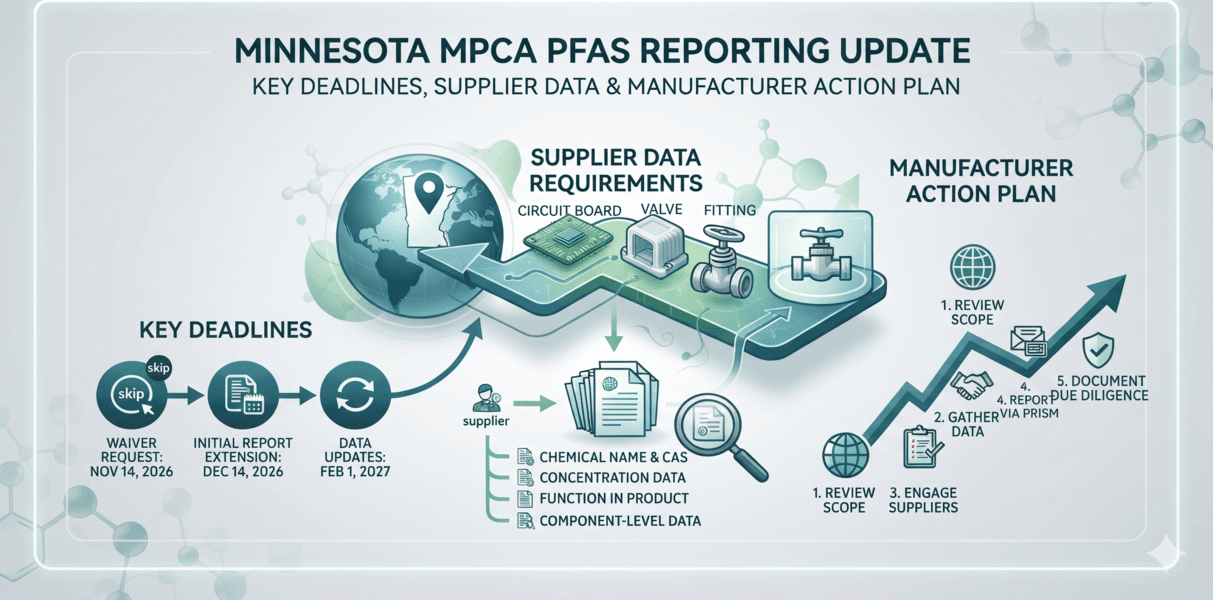
Master Minnesota MPCA PFAS reporting mandates. Get key deadlines, supplier data requirements, and compliance steps for your supply chain.
Introduction: Minnesota PFAS Reporting – Why Manufacturers Need to Act Now The Minnesota Pollution Control Agency (MPCA) has highlighted important next steps for manufacturers under Minnesota's PFAS in Products Reporting requirements in its October 27, 2026 update. The update is particularly relevant for manufacturers that have already submitted their initial PFAS reports but still have incomplete product information because of missing supplier declarations or unresolved supply-chain data. With two important dates approaching – November 14, 2026, for certain waiver requests and December 14, 2026, for manufacturers granted reporting extensions – businesses should review their PFAS reporting status, supplier information and outstanding data gaps. The key message for manufacturers is that submitting an initial PFAS report does not necessarily end their responsibility. They must continue requesting missing information from suppliers and update their reports when new information becomes available. For manufacturers selling, offering or distributing products in Minnesota, understanding these requirements is essential to maintaining regulatory readiness and managing product-level chemical information. 1. What Is the October 27, 2026 MPCA Update? The October 27 update highlights the importance of completing PFAS reporting activities and continuing supplier engagement, even after an initial report has been submitted. The key points manufacturers should understand are: Manufacturers with approved reporting extensions must submit their initial reports by December 14, 2026. Manufacturers planning to request a reporting waiver after receiving an extension must postmark their waiver requests by November 14, 2026. Manufacturers with incomplete supplier information must continue requesting the missing data. Newly obtained information relating to previously incomplete reports must be reported by February 1, 2027. Manufacturers should begin data entry early to identify potential reporting questions or technical issues. These requirements reinforce the importance of maintaining an organised supplier information collection process rather than treating PFAS reporting as a one-time exercise. 2. Important Minnesota PFAS Reporting Deadlines for 2026–2027 Manufacturers should distinguish between the initial reporting deadline, extension-related reporting and subsequent annual updates. Deadline Requirement September 15, 2026 Initial PFAS reporting deadline November 14, 2026 Waiver request deadline for eligible manufacturers with extensions December 14, 2026 Initial reporting deadline for manufacturers granted extensions February 1, 2027 Deadline for reporting newly obtained information and applicable annual updates Important: The December 14 deadline does not apply automatically to every manufacturer. It applies to manufacturers that received an approved reporting extension. Similarly, a waiver is not automatic. Manufacturers must demonstrate that equivalent PFAS product information is publicly available and verifiable. Waiver requests must follow MPCA's prescribed submission process, including mailing the required form and applicable payment. 3. Who Must Comply With Minnesota's PFAS Reporting Requirements? Minnesota's PFAS reporting requirements apply to manufacturers of products that are sold, offered for sale or distributed in Minnesota and contain intentionally added PFAS. The reporting obligation can apply even when the manufacturer is located outside the United States. Under the requirements, the definition of manufacturer can include: The company that physically produces the product. The company that contracts another organisation to manufacture products under its brand or label. The importer or first domestic distributor where the original producer or brand owner has no US presence, as applicable under the rules. The requirements also cover products sold exclusively through online channels when they are offered for sale or distributed in Minnesota. Certain exclusions apply, including products manufactured before July 1, 2023, and other specific statutory or regulatory exemptions. What does this mean for international manufacturers? A company based in Europe, Asia or another region may still have reporting responsibilities if its products are sold or distributed in Minnesota. Therefore, manufacturers should evaluate their US distribution channels and determine whether their products fall within the reporting scope. 4. What Information Must Manufacturers Collect for PFAS Reporting? PFAS reporting requires more than identifying whether a finished product contains PFAS. Manufacturers need relevant product and chemical information, including: Product description or product category. PFAS chemical names and identifiers. PFAS concentration information. The function or purpose of PFAS in the product or its components. Relevant manufacturer information. Information about the authorised reporting representative. The information may need to be collected at the product or homogeneous-material/component level, depending on the reporting requirements. This creates a significant challenge for manufacturers with complex bills of materials (BOMs), multiple suppliers and products containing numerous materials and components. For example, a finished electrical assembly may include: Plastic housings. Electronic circuit boards. Insulation materials. Cable assemblies. Surface treatments. Adhesives and sealants. Protective coatings. A manufacturer may not have direct visibility into the chemical composition of every material used in these components. Consequently, obtaining reliable PFAS information requires structured supplier engagement and material-level data management. 5. Missing Supplier Information: What Should Manufacturers Do? One of the most important aspects of the MPCA requirements is the responsibility to continue requesting information from suppliers. A supplier's failure to respond does not automatically remove the manufacturer's reporting responsibility. Where information is unavailable, manufacturers are expected to: Continue requesting the required information from suppliers. Maintain records of supplier communication and follow-ups. Report using the best available information and permitted unknown values, where appropriate. Update previously submitted reports when new information becomes available. Retain supporting documentation demonstrating due diligence. What does MPCA expect from supplier due diligence? Under Minnesota Rule Chapter 7026, manufacturers must demonstrate reasonable and ongoing efforts to obtain the required information. This includes: 1. Early supplier communication Manufacturers should initiate information requests early enough to allow suppliers to investigate their material composition and chemical data. 2. Multiple communication channels Supplier engagement should not be restricted to a single email. Manufacturers can use emails, telephone calls and supplier information systems. 3. Regular follow-ups If suppliers do not respond, manufacturers should continue following up until the required information is obtained. 4. Documented communication Records should include supplier requests, follow-up emails, responses and instances where suppliers have not responded. 5. Long-term record retention Manufacturers must maintain the required documentation for at least five years after the product is removed from the supply chain. This is particularly important for businesses with large international supplier networks. 6. What Happens If a Manufacturer Has Already Submitted an Incomplete PFAS Report? Submitting an initial report with incomplete supplier information does not mean the manufacturer can stop collecting the missing data. Manufacturers should continue their supplier outreach activities even after submitting their reports. If additional information becomes available, the relevant product reporting information must be updated in accordance with the applicable requirements. The February 1, 2027 reporting date is particularly important for manufacturers that receive additional information after submitting an incomplete initial report. For example: A manufacturer submits a PFAS report for an electrical product using the information available from its suppliers. At the time of submission, one component supplier has not confirmed the chemical composition of its insulation material. The manufacturer documents its supplier follow-up activities and reports using the information available and permitted reporting options. Two months later, the supplier provides additional chemical information confirming the presence of an intentionally added PFAS substance. The manufacturer must evaluate the newly obtained information and update its reporting as required by the applicable February 1, 2027 deadline. The important takeaway: Initial reporting and ongoing supplier information collection are connected activities. Manufacturers should maintain a process for tracking and updating information after submission. 7. What Is PRISM and How Is It Used for Minnesota PFAS Reporting? The Minnesota Pollution Control Agency uses the PFAS Product Reporting Information System for Manufacturers (PRISM) to collect PFAS-related product information. Manufacturers and their authorised representatives use PRISM to submit reports and pay applicable fees. The system supports reporting information about products containing intentionally added PFAS. Key reporting activities include: Creating and managing manufacturer reporting information. Entering product and component information. Providing PFAS chemical details. Reporting applicable concentration information. Identifying the function of PFAS in products. Managing reporting submissions and applicable fees. The MPCA established a one-time initial reporting fee of USD 800 per manufacturer under its reporting and fees rules. Manufacturers should ensure that the information collected internally and from suppliers is reviewed before entering it into PRISM. It is also important to understand that CDX, spreadsheets and other supplier data management tools can support information collection, but they do not replace the official PRISM reporting submission. 8. Practical Action Plan for Manufacturers Before December 14, 2026 With the December deadline approaching, manufacturers that received approved extensions should prioritise the following activities. Priority Recommended action 1 Confirm whether the company received an approved MPCA reporting extension. 2 Identify all products within the PFAS reporting scope. 3 Review product BOMs and component-level material information. 4 Identify suppliers that have not provided PFAS declarations. 5 Send follow-up requests to suppliers with missing information. 6 Document supplier communications and responses. 7 Review available PFAS chemical and concentration information. 8 Prepare and validate the information required for PRISM. 9 Submit the applicable report before the reporting deadline. 10 Establish a process for ongoing supplier follow-up and reporting updates. Manufacturers should avoid waiting until the final days to begin data collection and PRISM preparation. A delay in supplier responses can create additional pressure during the final reporting stage. 9. How Can Manufacturers Improve PFAS Supply Chain Data Management? PFAS reporting highlights a broader challenge for manufacturers: the lack of consistent chemical and material information across their supply chains. Many organisations already collect supplier declarations for other regulatory requirements, such as: EU REACH and SVHC. EU RoHS. SCIP. TSCA. Persistent Organic Pollutants (POPs). California Proposition 65. Conflict Minerals (CMRT and EMRT). IEC 62474. However, having these declarations does not automatically establish whether a product meets Minnesota's PFAS reporting requirements. Manufacturers should consider developing a centralised material information management process that connects: Product and BOM information. Supplier declarations. Chemical substance information. Material composition. PFAS identification and screening. Regulatory assessment. Supporting evidence and document retention. Periodic data review and updates. A structured approach can help reduce repeated supplier requests, improve information traceability and support multiple regulatory reporting activities. 10. Frequently Asked Questions About Minnesota MPCA PFAS Reporting Q1. What is the latest MPCA PFAS reporting deadline in 2026? The initial reporting deadline for manufacturers granted an approved extension is December 14, 2026. The original general initial reporting deadline was September 15, 2026. Q2. What is the November 14, 2026 deadline? November 14, 2026, is the deadline for manufacturers that received a reporting extension and subsequently intend to request a waiver. The waiver request must demonstrate that equivalent PFAS information is publicly available and verifiable. Q3. Do manufacturers need to continue contacting suppliers after submitting their PFAS report? Yes. Manufacturers must continue requesting missing supplier information even after submitting their initial reports. They must also document their due diligence activities. Q4. What happens if a supplier does not provide PFAS information? Manufacturers remain responsible for reporting. They should continue requesting the required information, document their efforts and use the best available information, including permitted unknown values where appropriate. Q5. When must newly obtained supplier information be reported? New information received after an incomplete initial submission must be reported by February 1, 2027, in accordance with the applicable reporting requirements. Q6. Does Minnesota PFAS reporting apply to manufacturers outside the United States? Yes. The requirements can apply to manufacturers located outside the US if their products are sold, offered for sale or distributed in Minnesota and contain intentionally added PFAS. Q7. Does submitting a PFAS report through PRISM complete all future obligations? No. Manufacturers must continue supplier engagement, maintain required records and provide updates when applicable new information becomes available. Q8. Does an existing REACH or RoHS declaration satisfy Minnesota PFAS reporting? Not automatically. REACH and RoHS declarations address different regulatory requirements. Manufacturers need to evaluate the available information specifically against Minnesota's PFAS reporting requirements. Conclusion: PFAS Reporting Requires Continuous Supplier Data Management The October 27, 2026 MPCA update reinforces an important point for manufacturers: PFAS reporting is not simply a submission exercise. It requires ongoing supplier engagement, reliable product information and documented due diligence. Manufacturers with approved extensions should prioritise their December 14 reporting deadline, while those considering eligible waiver requests should pay attention to the November 14 deadline. Businesses that have already submitted reports should not overlook incomplete supplier information. Continuing to collect and validate chemical data will be essential for applicable updates due by February 1, 2027. As product chemical reporting requirements continue to expand, manufacturers will benefit from establishing a consistent process for collecting, validating and maintaining supplier material information. Visit GS Comply Solutions to learn more about our services. Official References Minnesota Pollution Control Agency – Reporting PFAS in Products MPCA – PFAS in Products: Reporting and Fees Minnesota Rules Chapter 7026 – PFAS Reporting Disclaimer: This article is intended for general regulatory information and awareness. Manufacturers should consult the applicable Minnesota statutes, rules